
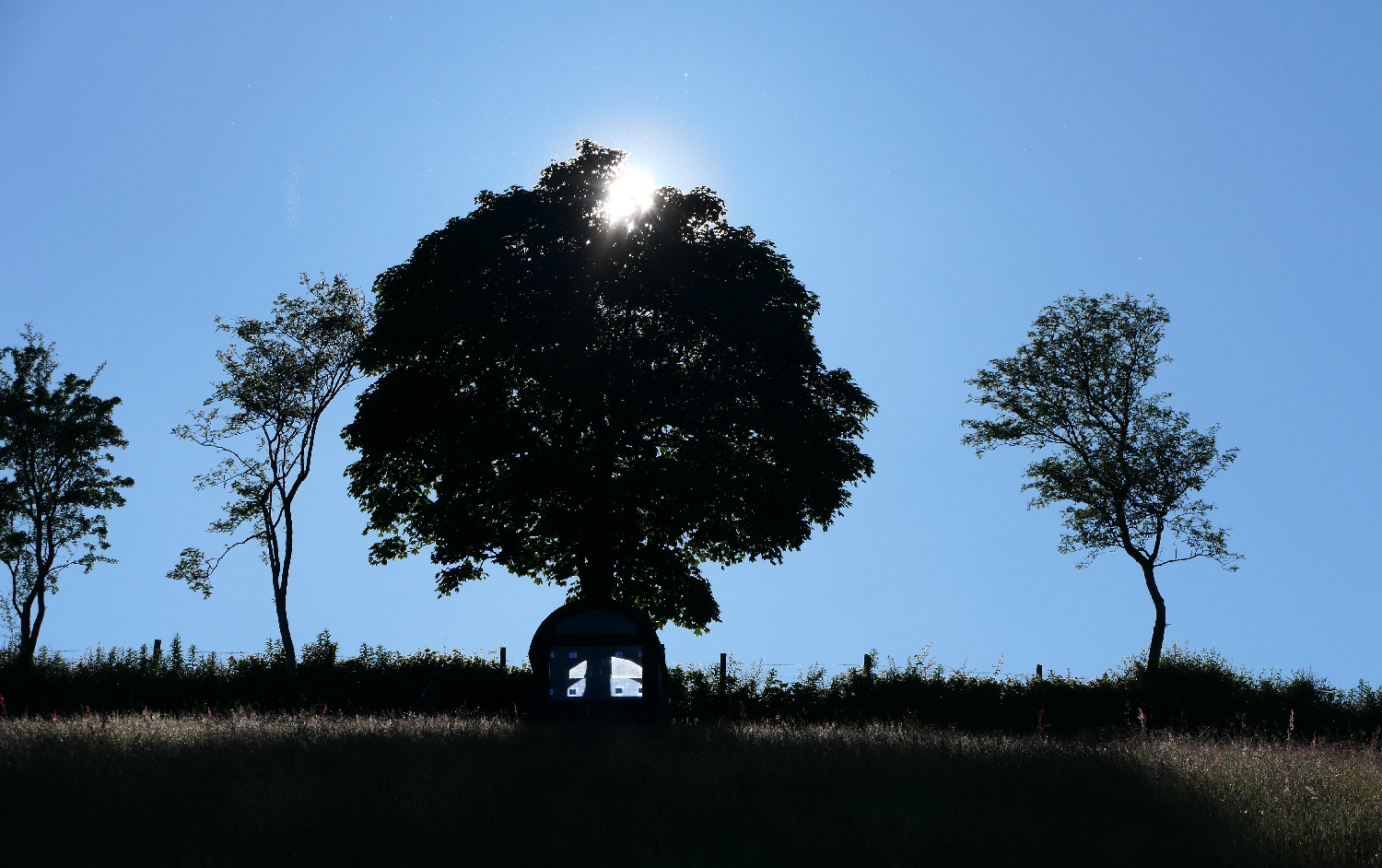
 Hats off to anyone who can identify the material above with its own aged patina, which we found during a recent garden visit. The complete element is shown later on.

“To know fully even one field or one land is a lifetime’s experience. A gap in a hedge, a smooth rock surfacing a narrow lane, a view of a woody meadow, the stream at the junction of four small fields – these are as much as a man can fully experience.”
I’ve included this quote from Irish poet Patrick Kavanagh once before on these pages, and indeed in the introduction to my own small book of words and images. It came to mind again recently after thinking about how someone reacts to a garden or special place on their first visit.
What do they notice? What contributes to their enjoyment, or not?
It can surely be one of the most multi-sensory of all human experiences. And one where external influences entirely outside the control of the visitor, might make, break or at least significantly mould the lasting impression that’s taken away.
Change the season, the light, the weather, the noise or sounds, the scents, and different memories might linger. If indeed any memories linger of time spent in someone else’s special place. After all, returning to Kavanagh’s words, how on earth can such fleeting visits ever dive into the depths of understanding of the complexities and details of a garden or landscape, that the owners will have acquired over years of living and loving that landscape.
No matter how many minutes or hours are spent whizzing around a new garden, inevitably visitors’ take-home impressions are mere fleeting snapshots, perhaps literally. Postcards from the edge of busy lives.
Or maybe, very rarely, something more dramatic and illuminating seeps into one’s consciousness and memory.
And impacts one’s dreams.

__
We were delighted that we’ve welcomed some special visitors to Gelli Uchaf, our own special place, or lle arbennig, this June, and now extending into our last week of opening in early July. I have no idea how they might reflect on their visits in the long term, although we know that they enjoyed their time here, and we really enjoyed meeting them.
Firstly, we were thrilled to greet Liz Ware, the founder of the charity Silent Space. Which was established by Liz in 2016 to “create opportunities for silent reflection in some of our favourite green places – in the UK and beyond”. And for visitors to “Take time to be peaceful in beautiful and biodiverse gardens.” Last year, after we’d visited a Silent Space at Hidcote in late 2022, we set up our own silent space in The Hut, which you can read about here.
 The forecast for Liz’s whistle-stop tour of the four Silent Space gardens currently in the scheme in Wales (which she hadn’t managed to visit before), didn’t look promising. Wet weather gear was definitely advisable. The day before she arrived, when she’d been to see the Silent Space at the National Botanic Garden of Wales, had been a dour day of persistent rain and grey skies. However, for the nearly 2 hours she was with us, the rain stayed away, the sun shone, and Gelli Uchaf looked as lovely as it can at this time of the year.
Five minutes after she’d left us, we had a heavy shower. We feel a great rapport with Liz, and what her aims for the charity are. We were so pleased that she enjoyed the garden and our own Silent Space, once we’d walked through the upper hay meadow to the top of Longevity Hill. Liz mentioned she was going to call in at Nant-Y-Bedd garden, the last of her garden visits on her way home the following day, which made me look it up and plan our own visit for a couple of weeks later.
Shortly after Liz’s visit we were delighted to welcome Gwyn and Anne to the garden. Gwyn (G) had emailed me over 4 years ago, out of the blue, after finding our website, and mentioned that:
“The farm was owned by my great grandfather until about 1940. His name was Thomas Jones. My mum is nearly 95 now and has fond memories of her holidays at the farm back in the 1930s. She remembers the fire opening up into the skies and her grandmother, Rachel, churning the butter. She also mentions the funeral of Thomas Jones complete with carriage and horses with a long procession winding it’s way to the chapel. One day, when we’re in the area I’d love to visit. I’ve never been to the farm but as a boy, I remember Rhydcwmerau Mill where one of my grandmother’s sisters lived.
I’ve seen the photos of the gardens but I’d love to show my mum a photo of the exterior of the house if there’s one accessible? I hope to hear from you”.
I, (J) replied thus:
“It’s always interesting to hear of previous inhabitants of this very special place – we’ve never seen any photos dating back to that period though. It’s wonderful that it’s so well remembered by your Mum. When we acquired it, it was in a bit of a sad state – pics attached – having been unoccupied for about 30 years. It’s much better now after 25 years of us working on the house and the land. I rarely photo the whole of the house, but hope the attached pics jog some memories for your Mum.”
The photo exchange below was thus completed, whilst other things were happening in the world, back in February 2020.


Further emails with more information followed, gradually piecing together a little more of the history of this place:

OLYMPUS DIGITAL CAMERA

OLYMPUS DIGITAL CAMERA

OLYMPUS DIGITAL CAMERA

OLYMPUS DIGITAL CAMERA
You probably can’t make it out, but the cart has the words “rich cream and eggs daily” painted on its side – no Tesco delivery vans back then. Really local, fresh produce was delivered by horse and cart

OLYMPUS DIGITAL CAMERA

OLYMPUS DIGITAL CAMERA
J:
“Thanks very much for the photos and press cuttings which are really interesting on several levels – first we had heard from occasional meetings with folk in Gwenda’s sub post office in the village (sadly closed several years back) that there had been a family with 10 children living at Gelli Uchaf around 1900. Moreover that they had their own family choir which used to perform locally – we now know who they were!
We have always felt that there is something very special about this place – almost magical. Other visitors have sometimes commented that they feel this. It has always been a happy home, and the fact that your distant relatives spent 50 years happily married here and bringing up a family like that in what is frankly a harsh environment all those years ago, without all the mod cons, sort of reinforces this sense of a continuum of specialness about the place.
You might be interested that inspired by living here, over many years, we’ve tried to capture elements of it – firstly now through our website and garden, but also earlier on in 2008, we recorded a CD of (mainly) Welsh songs in the house at Gelli Uchaf, by the Llandovery Male Voice Choir – their very first CD recorded in their 60 year history. Sadly at the last minute their choir mistress felt it wasn’t quite up to standard for it to be commercially produced, but we made copies for many of the 30 or so choir members who’d packed into what was the old milking parlour to make the recording on our piano on a very memorable day – all this influenced by our knowledge that a family had lived and sung here many years ago. If you click here, you’ll see a few pics and read a bit more about it.”
Secondly and much earlier, my younger brother Mark, who read English at Oxford, and won the top university poetry prize whilst he was there, wrote us a special poem for us (about) and after staying here for 10 days very early on in our restoration of the buildings. Subsequently I used this as the starting point to make a film about a year spent at Gelli Uchaf in 2010, which went on to get a prize at the (rather discredited now) Swansea Bay Film festival. You can read about this on these links.
I’m mentioning all this because you might be interested by the inspiration and creativity which we’ve received from living here over many years, and hope that it might fascinate your mum too.”
G replied:
“I showed the pictures of the house to my mum who, although her eyesight is failing, saw enough to bring back some nice memories. She always talks about her holidays to Rhydcwmerau which were some of the happiest times of her life! My grandmother was Nellie (as detailed on the press cutting). After going to the County School (I believe in Llandeilo), she became a teacher in the local school in Manorbier. She met her future husband Thomas and after a long engagement (spanning his service in the first world war), they moved to Pontypool and then to Newport where they bought a newspaper shop. In the context of Mark’s poem, there is an earlier literary connection to the farm. The cousin of my great grandmother, Rachel, was D Gwenallt Jones who was an important Welsh literary figure. Details are on Wikipedia. He was a conscientious objector during the first world war and spent some time staying at the farm.”
I now realise that I’d already written about Gwenallt, in a very early post on this blog from November 2011. And included this poem, Rhydcymerau, which he’d written in about 1951, beautifully filmed and read here (in translation) on this video produced by Huw Davies.
Once again for Gwyn and Anne’s visit the weather was lovely and it was wonderful to share some time with them both, in between some hay making and shearing!
 We were also able to show them inside the house and the special wicker chimney hood which Gwyn’s mother had often mentioned. As well as the fabulous, and now completed set of views of the landscape scenes we (sometimes) enjoy. Four years in the making, with one for each month, and produced in soft pastel by Fiona. A true magnum opus, and in the kitchen’s (gegin) often dark interior, a reminder that the grey weather and rain will surely pass.


It was wonderful to have welcomed and met yet more people with historical ties to this special place. Over the years, we have had several such meetings, a sure sign that this place has a fondly remembered presence – not just for us, but previous residents or stewards.  Many thanks to Gwyn and Anne for seeking us out, and for allowing me to include copies of the emails and his photos in this post.
The day after writing this, I met Glyn, still one of our neighbours and the farmer who sold Gelli to us 31 years ago. He told me that he’s just put the farm on the market. At the age of 80, he thinks it’s time to think about retiring! So a new storyline in the ongoing history of these hills and valleys is likely to be just around the corner.
I’m so glad that I managed to record this interview with Glyn nearly 3 years ago. It includes some of his memories of years spent in this place from way back in 1945 when his father bought the farm, up until when he passed the baton over to us. Over the years he’s been the most lovely, perfect neighbour, and has brought several of his relatives here, and we’ve shown them how the old buildings and land look now.
Jogging memories, or creating new ones. We wish him and his wife every happiness in their new home, wherever and whenever the move actually happens.
__
And now for some reflecTions on other special places.
 I’d read about another special place a few months ago, Stancombe Park, after discovering that it not only had a Grade 1 listed garden, but that you could also stay in a unique Doric Temple, set within its grounds. I took the plunge and booked a short break away, as a joint birthday treat. Timed so that we might be able to visit the more well known gardens at Kiftsgate Court, when its eponymous enormous rambling rose, was in flower. The rest of this post is an attempt to record our visits to these two gardens, with a trip to Nany-Y-Bedd on the journey home.
But how to begin? To capture the magic of our trip to Stancombe Park?
We arrived and followed the long, curving Park Lane, flanked with hundreds of yards of honey coloured Cotswold dry stone wall, reading the detailed instructions that Harry, the co-owner, had sent us. We were looking for the mosaic T set into the wall at the drive entrance. And there it was, and even better, a couple of chaps with loppers battling in the hot late afternoon sunshine, removing mature ivy from this section of the wall, who confirmed that we were heading the right way.
Except that these weren’t estate employees, but the current joint owners of the Stancombe partnership, Harry and Edge Llewellyn, who greeted us by name and introduced themselves. It set the tone for our very happy stay, when at different times we bumped into two other family members, as well as Peter, the longstanding gardener. All part of the small team that somehow manages to keep the huge expanse of grounds at Stancombe looking so lovely, and well tended. We are in awe of how they manage this. 
After such an unexpected personal greeting, we drove on, down a 1400 yard private driveway snaking over an undulating meadow. Past a row of flanking, unfamiliar small trees, possibly cockspur thorns, and further down towards a block of mature woodland, with views across the valley to the main house of Stancombe (viewed from the other side of the valley, above).
Gradually piecing together a timeline and history for this place I discovered that the original house was destroyed by a fire in the late 1800’s. What one sees now is a beautiful replacement in Cotswold stone. Harry’s wife later told us that the fire meant a lot of documents relating to the history of Stancombe had been lost, so piecing together a more detailed history is a long term project that Harry is enthusiastically pursuing.
The Trees grew Taller (a theme for all three gardens) – a wonderful mix of pines, firs and massive ramrod-straight ancient Sweet Chestnuts, some of these dating back to the late 1700’s. Eventually, after stopping the car to capture this unique and inviting approach, we reached a wide, shaded turning circle, and parking space. Down some stone steps with an ancient iron hand rail, and then as we reached the bottom, we had our first glimpse of our base for the next 3 nights. (Thought one: an exciting approach to a hidden special place builds a sense of anticipation, as my brother Mark had captured in the line from his poem “In translation” inspired by, and written at Gelli Uchaf nearly 30 years ago – ‘And we were off the map. As gods, ghosts and the lost are’).
It was then that heady scents hit us, in the warm, late afternoon air. 
 A sublime, mix of Philadelphus ‘Belle Etoile’ and rambling roses, creating a unique sensual combination, as we walked round to the side entrance to the Temple, and got our first view of the lake, and setting.
There’s a short, drone-shot video on the Stancombe website which gives an overview of this scene, and then the drone flies into and back out of the Temple! So we both had a good idea of what we were likely to see, but being there in person was still a revelation.  The design, detailing and quality of craftsmanship evident throughout the building is exceptional.
 Enhanced by some very special furnishings and works of art – all reflections of how many people have had their creativity stimulated by time in this special place. Many representations in paint:
And paper:
And even a specially made celebratory cake, and photographs too. 
It inspired Evlyn Waugh, who lived nearby and visited often whilst writing Brideshead Revisited in front of the Temple thus:
“a stream it was named the Bride and rose not two miles away… [it] had been dammed here to form three lakes, one no more than a wet slate among the reeds, but the others more spacious, reflecting the clouds and the mighty beeches at their margin. The woods were all of oak and beech, the oak grey and bare, the beech faintly dusted with green by the breaking buds; they made a simple, carefully designed pattern with the green glades and the wide green spaces. Did the fallow deer graze here still? – and, lest the eye wander aimlessly, a Doric temple stood by the water’s edge of the connecting weirs. All this had been planned and planted a century and a half ago so that, at about this date, it might be seen in its maturity”.
However, it’s not just the building and its setting. As soon as we’d unpacked the car, we were off exploring the paths, tunnels and grottoes that create this lower garden, over 500 metres from the main house, and which are the essentially private domain of any guests staying at the Temple, whilst they are there. This aspect of being able to explore the place, from early in the morning to late at night certainly contributed to the very special experience.


As did the glorious warm weather.
And the more one looked, the more one noticed. A huge variety of Tall Trees, many festooned with enormous rambling roses in full bloom and scent. Straight as an arrow, long, stone-slabbed paths, some with pergolas, leading the eye to distant sculptures or features.
A dead straight, dead flat, slabbed path right at the lake edge with the classiest, heavy duty pergola I’ve ever seen. Incredibly solid, and original. Perhaps a reflection of the industry of William Purnell of Dursley, and his work as an iron master. 


 One can even read his patent application (specification) for a new method of creating high quality iron, which is held in the Wellcome collection. Dated 1787, it begins thus:
” I, William Purnell, of Dursley…Iron Master… one of the surviving partners of John Purnell late of Froom Bridge Mills in the parish of Frampton Upon Severn…Iron Master, deceased, send greeting”. (sic – To King George the Third).
Elsewhere in the grounds, behind a ‘new’ Millenium feature, there is an inset (we’re guessing moved and re-set at some point following the house fire) gravestone with reference to earlier members of the Purnell family, including John. 

The works around the lake, including the Doric Temple were begun by Purnell Bransby Purnell, (PBP) who inherited the estate when his mother, the married daughter of William Purnell, pre-deceased her father, in the early 1800’s. PBP changed his name by deed poll adding the Purnell surname, and it’s thought that much of the works around The Temple were carried out by soldiers returning from the Napoleonic wars.
There are several beautiful small garden houses, and structures:


And several tunnels. It’s thought that these structures were added much later towards the end of the 1800’s by the then owner, PBP’s granddaughter Emily Anne’s (EA) husband. In 1882 she’d married the Rev David Edwards( DE). Local rumour has it that DE took a gypsy lover, and designed the long tortuous tunnels as routes for him to escape his wife, and meet up with his mistress in The Temple. EA was purportedly Junoesque in stature and unlikely to be able to follow hubby all the way down from the main house, and back again. Certainly any such assignations would require quite a degree of fitness.


These are amazing narrow brick-lined features that curved to total darkness, before revealing new path options, or steps, or grottoes.
Such inspired elements too – is there any other garden with both a whale bone mandible doorway arch framing a hull-inspired roof, leading to a secondary door arch, and a statue of Nefertiti?


You have to hunt hard, and look at the anatomy to find the separately located enormous whale vertebra, lying beached, just beyond the Temple. Might these two items of whale skeleton have come from the Littleton whale, Which beached nearby in the Severn estuary in 1885, and at 68 feet long with a mouth of 12 feet, was probably large enough to provide such huge pieces of bone. It certainly created a local stir.

For the whole of my time there, I was mesmerised by the design axis of the building. Open the side entrance door and one of the level paths stretched into the distance. Turn around and the oak framed door and scene you’ve just looked at is reflected in an identically oak framed framed mirror at the far end of the Temple, reflecting back to? Infinity?

The visual power of this axis and imagery is exceptional. It’s impossible to photograph without the camera and photographer in scene, or at least, I couldn’t manage it.
One early morning, as I sat with a tea just inside the Temple doorway, I thought I spotted an animal cross this path, from right to left, beneath the draping rose blossoms. Was it a cat? I held my camera up, and waited. And a few minutes later, it re-crossed the path, from left to right.
A blurry, out of focus fox – almost at the point where a Mexican artist (prints of his imagery hang in the Temple’s simple but perfectly adequate kitchen), placed an imaginary tiger. Painted years previously.
“Did you get it?” Fiona asked me from the snug alcove bed.
Did I get it, indeed? I’m still wondering.
Is this place a mere folly? I think this word undervalues how amazing Stancombe’s water garden and the surrounding landscape is. A largely hidden valley made unique by many minds and much skilled manual effort over many, many years. A beautiful natural landscape enhanced by human hands.
Stancombe certainly inspired the previous owner – Harry’s uncle Nick Barlow, a photographer of international renown, to explore and document follies from around Europe. He co-produced a wonderful book, lying below a table in the Temple, capturing a huge variety of forms of whimsy, created over centuries, by people with special ideas and inspired by special places.
On our return I managed to buy our own copy. It’s a beautiful magical mystery tour of creative genius and whimsy from around Europe over the last few centuries, captured and framed with a wonderful eye for the composition of views.
I should add in what is inevitably a limited space review, that as well as the water garden park to explore, with Harry’s generous permission, we were allowed access to the other more formal gardens associated with the main house. 
 Reached by a 500 metre path, climbing up through more mature woodland and flanked by views across the meadow towards a second pond, there were yet more features – some ancient, some more modern, reflecting the ongoing creative expression of the owners.
 Turn a corner after the long climb, and the main house comes into view.
(Thought two: Perhaps a landscape of hills and valleys is naturally more appealing to the human eye, and forms a key part of special places – though I’m probably biased in this regard).
The formal gardens are a contrasting and complementary delight. They’re mainly the work of Harry and Edge’s grandmother, Gerda Barlow who with her husband acquired Stancombe in the 1950’s and designed, laid out and then managed the grounds with just the help of a single gardener in later years, Peter. She continued to work on them well into her 80’s.


Apart from the various formal borders and vistas shown here, there are yet more wonderful rambling roses, and sensitively placed sculptures. 


 And a gloriously subtly variegated Tulip tree, with flowers just beginning to open when we visited.

The day before we left, I wondered What3Words I’d choose to help find this place, if one were able to self-select them. I came up with Romantic, Exquisite, Inspired. (or maybe that should be Inspirational?) I asked Fiona for her independent thoughts. She chose Paradise, Hidden and Whimsical.

It’s certainly a place for romantic dreamers, and being able to visit and enjoy it in the way that our very generous hosts allow, gives time for dreams and musings to blossom. Which is probably why we enjoyed it so much.
We’re very grateful to the Llewellyns for sharing it with complete strangers, so that visitors can have such a private experience. You only need to glance through the visitor’s book comments to realise that it has this effect on all who venture here.
Our fond memories will certainly stay with us, and if we start saving, we’d love to return sometime.
________
A Kiftsgate rambling rose was one of the first we planted here, many years ago. And during her 3 visits to Gelli Uchaf at snowdrop time over the last 2 years, trying unsuccessfully to snatch a good light/weather window, garden photographer Sabina Rüber, had told us that it was her favourite garden. She’d been fortunate enough to visit it multiple times, (although before the public were let in) and produce the images for this book about the garden and its history.
Kifstgate Court is just over a busy hour’s drive away from Stancombe, and we arrived on a glorious morning just after the gardens opened, to find it already quite crowded. It has a lovely setting on the ridge of the escarpment looking out to the Malvern Hills, and an excellent cafe where we opted to have lunch outside in the sunshine. Which is when one of the inevitable consequences of visiting a ‘destination garden’ kicked in – the extraneous discussions from neighbouring tables about ongoing medical and surgical treatments didn’t quite sit with the anticipation of the garden’s delights.
The garden has been designed over a 100 years, by 3 successive female gardeners. It is immaculately kept, with many very well grown plants and a mass of flowers.

 There are some more contemporary creations, such as the formal water sculpture in the old tennis court.
However, we didn’t particularly feel we wanted to linger anywhere, due to people and voice pressures, until we climbed down steep steps cut between (more) Tall mature Scot’s pine Trees.
 This terrain seemed to deter 95% of the mainly older garden visitors who stayed on the level around the house. The views were even more lovely from here, although I was amazed to see that on a hot day, there wasn’t a single butterfly on a group planting of Buddleia. Wrong cultivar? Or few butterflies?
Climbing back up the hill, we took a small gate onto a woodland path running through a (now over) bluebell wood. After a short distance, we reached a simple bench seat, with no view to speak of. Why place a simple seat here, we thought, deep amongst trees? We sat down for a pause and soon discovered why.
The bird song at this point was exceptional, in what must have been the local bird populations’ amphitheatre of song. Not a designated Silent Space, yet it surely could be. We were serenaded continuously, and no one else walked this path. It was probably the highlight of our trip to Kiftsgate, and we’re sure the seat was located for exactly this reason – the owners knew that this was a focal point for natural, auditory pleasure.
We left pleased that we’d made the journey, but probably not wanting to visit again, although the cafe staff told me that September was often a much nicer and quieter time to visit. Clearly a special place, but not for us a very special visit.
______
Finally, and too soon we headed back into Wales, on a cloudier day. The skies darkened. Spits and spots of rain hit the windscreen as we passed Raglan castle, and wondering whether we’d missed the boat for another snatched haymaking session when we got home after this rare weather window, the random track selection from our audio USB song selection played us this.
A change of culture, scene and work welcomed us back to this land.
“Ei Di’r Deryn Du?” (Will You Go, Black Bird?)
A traditional Welsh song, from her album Tir (Land), by Cerys Matthews. The song is in Welsh and English, and the languages alternate every line. The English translation below was written by Richard B Gillion:
Will you go, Black Bird
To my dearest love?
O quest for my dear lass,
For I’m so deep in love.
I cannot see anywhere
Such a damsel in my sight
As the girl fair of colour –
She is a beauty bright.
Her hair is golden yellow,
Just like a ring of gold,
And her countenance like white snow –
The truth it must be told.
___
And so on to Nant-Y-Bedd garden (‘the stream of the grave’).
“Nant-y-Bedd is a 10 acre organic garden and woodland located at 1200 feet up in the Black Mountains in the Bannau Brycheiniog (Brecon Beacons) National Park in Wales. Sue has been gardening here for 40 years, assisted over the past 20 or so years by Ian.”
(Thought number 3: Special places and gardens seem to get their hooks into the residents. Who will likely hang around for as long as possible – typical average periods for staying in a single owned home have apparently risen in recent years, but are still below 10 years, way less than all the owners of the gardens mentioned in this blog post).
We knew from the above description on the garden’s website that this was going to be a very different garden visiting experience, as well as from this recently written text by the contemporary garden designer Sarah Price, who lives nearby in Abergavenny.
From a recent ‘Gardens Illustrated’ article:
“With so many selfseeders, it’s clear that the garden is constantly in flux. Sue relishes the dramatic changes, but keeps a semblance of artistic control.” 
Again we arrived early and were soon greeted by Sue and Ian who gave us a warm welcome, and clutching our excellent map of the garden paths, off we went. It’s a very special site nestling at the base of a deep cut valley surrounded by more Tall Trees.
  This time, the trees include massive mature Douglas Firs and other conifers pushing skywards throughout the garden and on the hillsides beyond. A challenging place to create a garden, Sue and Ian have chosen the route of a relaxed, very informal style of wild gardening incorporating many native self seeding plants. And to this they’ve added, with the help of local wood/land artist Mick Petts, some wonderful artistic and functional features.
Mostly made with trees felled on site, or very close by. The result is a peaceful, special place with a unique ‘chaise log’ Silent Space.


Cedric the seed sculpture. Emerging fern fronds shooting from a felled tree stump.

 And a trail of collected sheep and lamb skulls hanging from some of the mighty firs’ lower branches – presumably a nod to the name of this place.
We even disturbed a squirrel caught in the act of stealing. From a squirrel-proof bird feeder.


A good time to pause and listen to Eva Cassidy’s beautifully sung ‘Tall Trees In Georgia’ in its only live recorded form, from the excellent ‘Live at Blues Alley’.
(Thought four: Maybe the grandeur and history that Tall Trees contribute to a garden or landscape help to make it a special place?)
Sadly, all too soon we were on our way again, although delayed a little by trying to find a way out to Crickhowell and being stymied by a road closure sign on one of the tiny roads that criss-cross the valleys and hills in this part of the world.
And so back to Gelli, and an attempted hay making session which ended in having to trash the grass after 4 days, when 3 nights of (not forecast) rain wrecked it – the first time in our 11 years of haymaking we’ve had to do this.
However, our roses still looked lovely, the Geraniums glowed, and the few swallows this year put on a special show for me around the weather-vane.


